
An IEAT Free Zone is a designated area inside a Thai industrial estate where imported goods are treated as being outside Thai customs territory. In practice, import duties, VAT and excise tax are suspended for as long as the goods remain in the zone. For an export-oriented manufacturer or foreign investor, it is one of the most advantageous schemes available in Thailand. It is little known outside specialist circles, yet it deserves close attention, especially since a separate scheme, the Customs Free Zone, can offer similar customs benefits outside the industrial estates.
Last updated: October 2026
What is the IEAT and what does it do?
The IEAT (Industrial Estate Authority of Thailand) is a state enterprise under the Ministry of Industry. It was created by the Industrial Estate Authority of Thailand Act B.E. 2522 (1979) to develop and manage the country’s industrial estates.
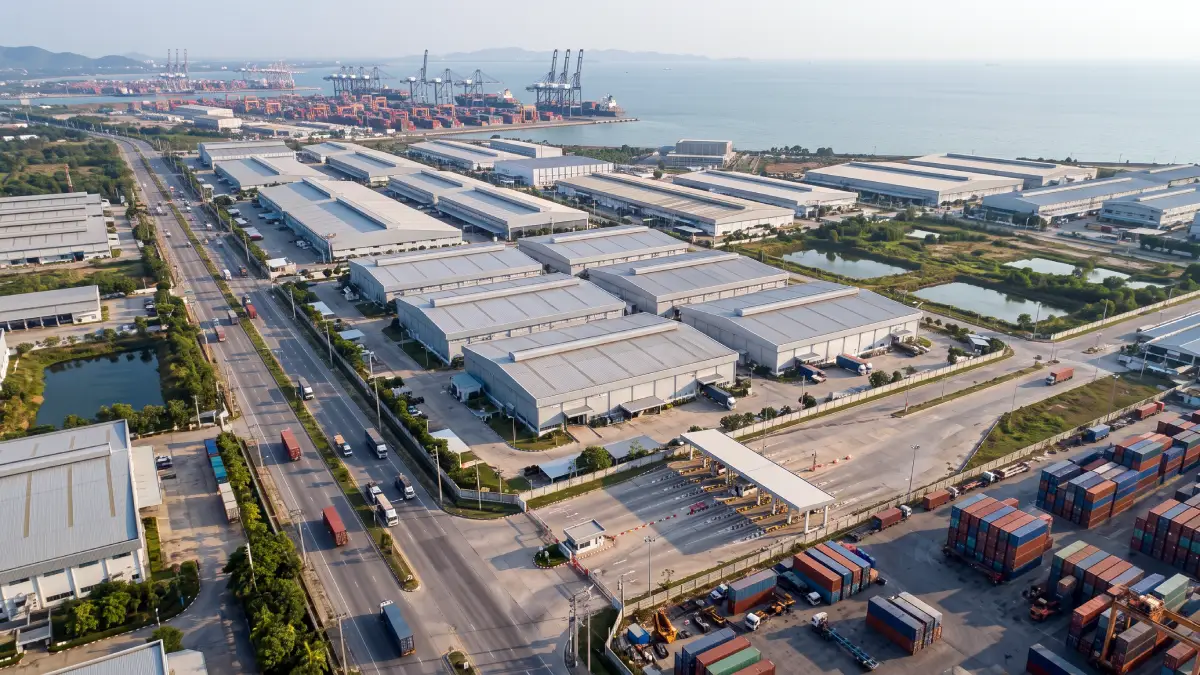
According to its latest annual reports, the IEAT oversees nearly 70 industrial estates in 16 provinces. Around 15 of them are operated directly by the IEAT; the others are run jointly with private developers such as WHA or Amata, but remain subject to IEAT regulations.
Each IEAT industrial estate can be divided into two distinct types of zone:
- The General Industrial Zone (GIZ): open to industrial and service activities. Customs benefits there are limited.
- The IEAT Free Zone: a zone with a special customs status, where goods are treated as outside Thai customs territory, with extended tax and customs privileges.
What are the concrete benefits of an IEAT Free Zone?
The main advantage of an IEAT Free Zone is the suspension of taxes and duties on incoming goods, with no time limit, for as long as they remain in the zone.
Customs and tax benefits
- Exemption from import duties on machinery, equipment, tools and raw materials used in production
- Exemption from VAT on the same flows
- Exemption from excise tax on goods imported for industrial or commercial use
- Exemption from export duties on goods produced in the zone and exported
- 0% VAT on Thai goods entering the zone, which are treated as exports
- No duties or taxes on goods transferred from one IEAT Free Zone to another
Non-tax benefits
- Land ownership for foreign companies: the IEAT Act is a legal exception to the general Thai rule that prohibits foreigners from owning land. In an IEAT industrial estate, a foreign company can own the land used for its operations, with the approval of the IEAT.
- Import and export of goods without quantitative restrictions
- No need for import licences for raw materials brought into the zone
- A One-Stop Service (OSS) for administrative procedures: land acquisition, construction permits, licences, visas and work permits
- Easier recruitment of qualified foreign staff
- Visas for the families of foreign employees
- Freedom to remit foreign currency abroad
- Can be combined with BOI incentives if the company also obtains BOI promotion
Logistics and infrastructure benefits
IEAT industrial estates provide integrated infrastructure: electricity, industrial water, natural gas, wastewater treatment, broadband, internal roads and, for some estates, direct access to an industrial port. Customs clearance is carried out on site by customs officers stationed in the estate, which considerably speeds up import and export flows.
Which IEAT industrial estates have a Free Zone?
Not every IEAT industrial estate includes a Free Zone. Estates whose official IEAT listing includes an IEAT Free Zone include:
- Laem Chabang Industrial Estate (Chonburi): next to Laem Chabang deep-sea port, Thailand’s largest container port. Its Free Zone covers nearly 1,000 rai, making it one of the largest. Ideal for export-oriented industries.
- Eastern Seaboard Industrial Estate (Rayong) and WHA Eastern Seaboard Industrial Estate (Rayong): automotive, electronics and petrochemical hubs in the Eastern Economic Corridor (EEC), about 27 km from Laem Chabang port.
- Amata City Chonburi Industrial Estate (Chonburi): one of the country’s largest estates, between Bangkok and the Eastern Seaboard.
- Bangpoo Industrial Estate (Samut Prakan): a multi-sector estate near Bangkok and Suvarnabhumi Airport.
- Bang Pa-In Industrial Estate (Ayutthaya): north of Bangkok, close to Don Mueang Airport.
- Northern Region Industrial Estate (Lamphun): light industry, electronics and agri-food in the north of the country.
Free Zone areas and available plots change over time. Before choosing a site, check the current zoning and availability directly with the IEAT or the estate developer.
Who can set up in an IEAT Free Zone?
IEAT Free Zones are intended for industrial and commercial activities whose main purpose is producing or trading goods, mostly for export. Pure service activities are generally not eligible for Free Zone status, but they can set up in the General Industrial Zone.
Activities commonly admitted in a Free Zone include:
- Manufacturing and assembly of industrial products
- Processing and packaging of raw materials
- Commercial activities linked to the import and export of goods
- Export-oriented warehousing and logistics
- High-technology, electronics, automotive and petrochemical industries
How to set up in an IEAT Free Zone: the steps
Setting up in an IEAT Free Zone goes through the IEAT One-Stop Service (OSS). The main steps are:
- Eligibility check: the planned activity must be compatible with the admission criteria of the target estate. The IEAT assesses the type of activity, the investment volume and the destination of the products.
- Application: filing the application with the IEAT, including the business plan, company information, the site project and forecast goods flows.
- Purchase or lease of land: land in an IEAT estate can be bought or leased. Foreign land ownership is allowed for the approved operations.
- Licences: through the OSS, the IEAT coordinates all required permits (construction permit, factory operation permit, customs procedures).
- Inventory control system: every Free Zone company must keep rigorous materials accounting and full traceability of goods flows. This is a permanent condition for keeping the customs privileges.
IEAT Free Zone and BOI promotion: two schemes that can be combined
A company located in an IEAT Free Zone can also apply for BOI promotion. The two schemes are not mutually exclusive; they complement each other.
BOI promotion brings additional tax benefits (corporate income tax exemption for a set period, import duty exemptions on machinery) and support for visas and work permits. The IEAT Free Zone brings permanent customs benefits on goods flows.
For large industrial projects, combining an IEAT Free Zone with BOI promotion is one of the most favourable investment frameworks available in Thailand.
What if no plot is available in an IEAT Free Zone?
This is one of the most common practical constraints: available plots in the Free Zones of the most attractive estates can be scarce, especially on the Eastern Seaboard and close to the main ports.
Few investors know that there is a second free zone regime: the Customs Free Zone, governed by the Customs Act B.E. 2560 (2017) and administered by the Customs Department, not the IEAT. A company that meets strict conditions can obtain a licence from the Director-General of Customs to establish a free zone on a site it owns or leases, including outside IEAT industrial estates.
Goods in a Customs Free Zone are also treated as outside Thai customs territory, with import duties and taxes suspended. The conditions are demanding, however:
- A Thai limited company with substantial paid-up capital, set by the Customs Department according to the type and location of the zone
- Ownership of the land or long-term land rights over the proposed area
- Infrastructure, security systems and an electronic inventory control system approved by Customs
- Dedicated office space for customs officers on site
- Strict compliance with Customs control measures, regularly tightened by new notifications
The Customs Free Zone does not include the non-tax benefits of the IEAT Act, such as foreign land ownership or IEAT visa support. For these, BOI promotion can sometimes take over. The criteria change regularly, and assessing eligibility and preparing the application requires specialist support.
If you want to explore this option for your project, contact our team. We assess the feasibility with you and support you through the procedure.
Key takeaways
- An IEAT Free Zone is an area inside an industrial estate where imported goods are treated as outside Thai customs territory: import duties, VAT and excise tax are suspended with no time limit.
- The IEAT oversees nearly 70 industrial estates. Free Zones are found in estates such as Laem Chabang, Eastern Seaboard, Amata City Chonburi, Bangpoo, Bang Pa-In and Lamphun.
- Foreign companies can own land in an IEAT industrial estate for their approved operations, a major exception to Thai land law.
- Eligible activities are mainly export-oriented manufacturing and trade. Pure services go to the General Industrial Zone.
- IEAT Free Zone status can be combined with BOI promotion, one of the most complete incentive packages in Thailand.
- Outside the industrial estates, a Customs Free Zone under the Customs Act offers similar customs benefits, under strict conditions and without the IEAT’s non-tax benefits.
- Every Free Zone company must maintain rigorous materials accounting and traceability: this is the mandatory counterpart of the customs privileges.
Frequently asked questions about IEAT Free Zones in Thailand
What is the difference between an IEAT Free Zone and a General Industrial Zone?
The General Industrial Zone (GIZ) is open to industrial and service activities, but without extended customs privileges. The Free Zone additionally suspends import duties, VAT and excise tax on imported goods for as long as they remain in the zone. The Free Zone is reserved for industrial and commercial activities that are mainly export-oriented.
Can a foreign company own land in an IEAT industrial estate?
Yes. It is one of the few legal exceptions to Thai land law, which normally prohibits foreigners from owning land. The IEAT Act allows foreign companies to own land in IEAT industrial estates, in both the General Industrial Zone and the Free Zone, for the industrial use approved by the IEAT.
Can IEAT Free Zone status be combined with BOI promotion?
Yes. BOI promotion brings tax benefits (corporate income tax exemption, duty exemptions on imported machinery) and visa and work permit support. The IEAT Free Zone brings permanent customs benefits on goods flows. Combining the two is one of the most favourable frameworks for an industrial project in Thailand.
Which activities are eligible for an IEAT Free Zone?
Industrial activities (manufacturing, assembly, processing) and commercial activities that are mainly export-oriented. Export-oriented warehouses and logistics platforms may also be eligible. Pure service activities (consulting, IT, finance) are generally not eligible for Free Zone status and set up in the General Industrial Zone instead.
What obligations come with Free Zone benefits?
Every company in an IEAT Free Zone must keep rigorous materials accounting and a traceability system for goods flows. Each movement of goods into or out of the zone must be declared to the IEAT and Customs, and the company is subject to their inspections. In case of non-compliance, customs privileges can be suspended or withdrawn.
Is it possible to obtain free zone benefits without being in an IEAT industrial estate?
Yes, through a different regime: the Customs Free Zone, licensed by the Customs Department under the Customs Act B.E. 2560. A company can establish one on a site it owns or leases, subject to strict conditions on capital, infrastructure and inventory control. It offers similar customs benefits, but not the IEAT’s non-tax benefits such as foreign land ownership.
How long does it take to set up in an IEAT Free Zone?
It depends on the estate, the complexity of the project and how complete the application is. As a general rule, allow several months between filing the application and obtaining all permits. The IEAT One-Stop Service centralises the procedures and allows the different licences to be processed in parallel.
What happens if a Free Zone company sells part of its production on the Thai domestic market?
Goods leaving the Free Zone for the Thai market are treated as imports. Duties and taxes then become payable, in principle on the imported content, while Thai raw materials incorporated in the products benefit from relief. Only the share of production that is exported keeps the full exemption.
Conclusion
IEAT Free Zones are among the most competitive industrial investment frameworks in Southeast Asia. Permanent suspension of import duties and VAT, foreign land ownership and the possibility of combining them with BOI promotion give foreign investors an exceptional environment for export-oriented industrial projects. The main constraint remains the availability of plots in the most strategic estates, which is precisely where a Customs Free Zone can be an alternative worth exploring.
If you are planning an industrial project in Thailand and want to assess your eligibility for a free zone, whether in an IEAT industrial estate or under a Customs Free Zone licence, contact our team. We support you from the feasibility study to obtaining your licences.