

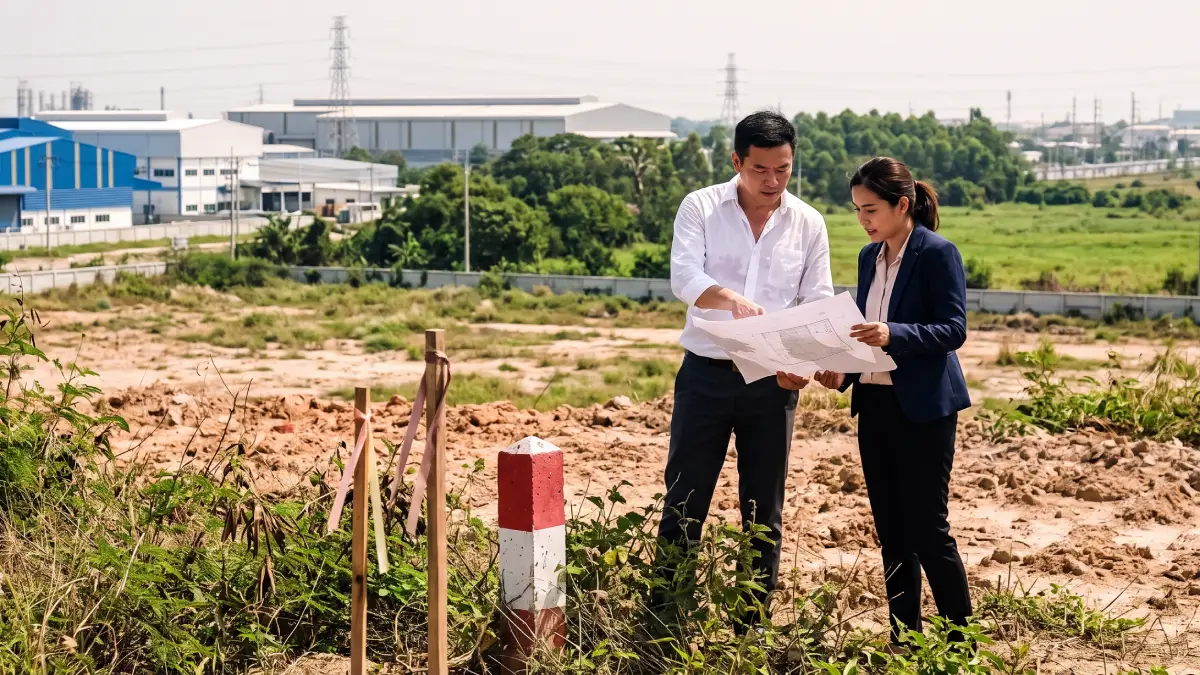
Yes, a foreign company can own land in Thailand, but in practice only through two specific legal routes: BOI (Board of Investment) promotion or an IEAT (Industrial Estate Authority of Thailand) industrial estate. Outside these two frameworks, Thai law prohibits majority foreign-owned companies from holding a land title. Understanding the difference between the two routes, and knowing which one fits your project, is therefore the first question to settle before any industrial real estate investment in Thailand.
For the detailed BOI rules (area caps, 50 million baht capital, excluded sectors and the e-Land procedure), see our guide to BOI land rules in Thailand.
Last updated: October 2026
Why can’t a foreign company freely buy land in Thailand?
The Thai Land Code reserves land ownership to Thai individuals and Thai legal entities. A company is treated as foreign when more than 49% of its capital is held by foreigners, or when foreigners make up more than half of its shareholders. Such a company cannot acquire a land title (Chanote) under ordinary conditions.
This restriction cannot be legally circumvented through nominee shareholding. Structures using Thai front shareholders are illegal, have been actively prosecuted since 2024–2025, and expose those involved to criminal penalties as well as the cancellation of the land transactions. They are not an alternative.
The two structured legal exceptions for foreign companies rest on two specific laws:
- Section 27 of the Investment Promotion Act B.E. 2520 (1977): the legal basis for BOI land rights
- Section 44 of the Industrial Estate Authority of Thailand Act B.E. 2522 (1979): the legal basis for IEAT land rights
The BOI: a conditional, capped land right
The BOI can allow the companies it promotes to own the land needed for their promoted activity. This right is conditional: it is tied to BOI promotion status and lapses if the company loses that status. The company must then sell or transfer the land within one year.
Since the new rules of December 2024 (BOI Notifications 16/2567 and Por. 8/2567), the BOI regime distinguishes three categories of land:
- Operating site: area assessed case by case depending on the project, with no fixed administrative cap
- Administrative offices: up to 5 rai (approximately 8,000 m²), minimum paid-up capital of 50 million baht, on a plot separate from the operating site
- Operational staff housing: up to 20 rai (approximately 32,000 m²), in buildings dedicated exclusively to employees of the promoted project, with the same 50 million baht capital requirement
Housing for executives and experts was abolished by the new rules. Since September 2025, certain sectors (metals, industrial chemicals, plastics) are also excluded from BOI land rights for majority foreign-owned companies, apart from a narrow exemption for large, well-established groups.
For the full detail of BOI land rules, read our complete guide: Can a Foreign Company Buy Land in Thailand? BOI Rules Explained.
The IEAT: land ownership inside industrial estates
The IEAT offers a fundamentally different land regime. In an IEAT industrial estate, a majority foreign-owned company can be granted permission by the IEAT to own the land used for its operations, with no fixed cap on the area. The right is tied to the active operation of the business in the estate, but it is broader and less exposed to administrative changes than the BOI land right.
If the company is dissolved or transfers its business, it must dispose of the land, to the IEAT or to the business transferee, within three years. Owning land in an industrial estate for residential purposes is prohibited, except for limited staff housing approved by the IEAT.
The IEAT oversees nearly 70 industrial estates in 16 provinces, around 15 of which it operates directly. Each estate can include two types of area:
- General Industrial Zone (GIZ): for industrial and service activities, with foreign land ownership permitted but no extended customs benefits
- IEAT Free Zone: the same land right, plus the suspension of import duties, VAT and excise tax on imported goods for as long as they remain in the zone
Estates with an IEAT Free Zone include Laem Chabang and Amata City (Chonburi), Eastern Seaboard and WHA Eastern Seaboard (Rayong), Bangpoo (Samut Prakan), Bang Pa-In (Ayutthaya) and the Northern Region Industrial Estate (Lamphun).
For the full detail of IEAT Free Zones, read our complete guide: IEAT Free Zone in Thailand: Benefits, Locations and How to Set Up.
Comparison table: BOI vs IEAT for land acquisition
| Criterion | BOI | IEAT |
|---|---|---|
| Nature of the land right | Conditional right tied to BOI promotion status | Ownership permitted by the IEAT, tied to operations in the estate |
| Area cap | 5 rai for offices, 20 rai for staff housing, operating site assessed by project | No fixed cap, assessed by project |
| Location | Anywhere in Thailand, subject to zoning | Only inside an IEAT industrial estate |
| Minimum capital | 50 million THB for office and housing land | No universal fixed threshold |
| Customs benefits | No (separate BOI incentives on machinery and raw materials) | Yes, in the Free Zone (duties, VAT and excise suspended) |
| Sectors | All BOI-eligible sectors, with metals, chemicals and plastics restrictions since September 2025 | Mainly manufacturing and export-oriented trade |
| Loss of the land right | Loss of BOI status: land to be disposed of within 1 year | Dissolution or business transfer: land to be disposed of within 3 years |
| Can be combined | Yes, with an IEAT location | Yes, with BOI promotion |
BOI or IEAT: how to choose?
The choice between BOI and IEAT depends above all on the nature of your project and your priorities.
Choose the BOI if:
- Your activity can operate outside a designated industrial estate
- You need geographical flexibility (a site in any province)
- Your project is in services, technology or another BOI-eligible non-manufacturing activity
- Your land needs are limited (offices, a small production site)
- You are mainly looking for corporate income tax benefits
Choose the IEAT if:
- Your activity is industrial manufacturing, mainly export-oriented
- You need a large area without an administrative cap
- You want permanent customs benefits on your goods flows (Free Zone)
- You need direct or close access to a deep-sea or industrial port
- You want a land right that does not depend on keeping a promotion status
Combining BOI and IEAT
The two schemes are not mutually exclusive. A company located in an IEAT industrial estate can also apply for BOI promotion. It then benefits from both the IEAT customs advantages and the BOI tax incentives: the most complete framework available in Thailand for a large industrial project.
Pitfalls to avoid
Three risky situations we regularly see in practice:
- The nominee structure: using Thai front shareholders to get around the land restrictions. It is illegal, criminally punishable, and the land title can be challenged at any time.
- Confusing the FBL with land rights: a Foreign Business License allows a foreign company to carry out certain activities in Thailand, but it grants no land rights. These are two entirely separate questions under Thai law.
- Treating a lease as ownership: under the Civil and Commercial Code, a lease is capped at 30 years, and Thai courts have ruled that clauses promising automatic renewal beyond that are not enforceable as such. For commercial and industrial projects, a separate 1999 law allows registered leases of up to 50 years, renewable once for up to 50 more years, under specific conditions. A lease is a solid tool, but it remains a right of use, not ownership.
Key takeaways
- In practice, a foreign company can only own land in Thailand through BOI promotion or an IEAT industrial estate.
- The BOI offers a conditional land right, tied to promotion status, capped by use, and usable anywhere in Thailand.
- The IEAT allows land ownership with no fixed area cap, but only inside designated industrial estates.
- In an IEAT Free Zone, land ownership comes with the suspension of import duties, VAT and excise tax on imported goods.
- The two schemes can be combined: a company in an IEAT estate can also obtain BOI promotion.
- Nominee structures are illegal and expose those involved to criminal prosecution and the cancellation of land transactions.
- A Foreign Business License (FBL) grants no land rights, a frequent confusion to avoid.
Frequently asked questions about land purchase by a foreign company in Thailand
Can a 100% foreign-owned company buy land in Thailand?
Yes, through BOI promotion or inside an IEAT industrial estate. Outside these two frameworks, a majority foreign-owned company cannot hold a land title in Thailand.
What is the difference between the BOI and the IEAT for buying land?
The BOI grants a conditional, capped land right that can be used anywhere in Thailand, but depends on keeping promotion status. The IEAT allows ownership with no fixed cap, but only inside designated industrial estates. The BOI suits geographically flexible projects; the IEAT suits large, export-oriented industrial projects.
Can BOI and IEAT be combined for land?
Yes. A company located in an IEAT industrial estate can also obtain BOI promotion. It then benefits from the IEAT land regime, the Free Zone customs benefits if it is in a Free Zone, and the BOI tax incentives.
Does a Foreign Business License (FBL) allow a company to buy land in Thailand?
No. The FBL allows a foreign company to carry out certain business activities in Thailand, but it grants no land rights. Business authorisation and land ownership are governed by separate laws.
What is a nominee structure and why is it risky?
A nominee structure uses Thai front shareholders so that a company appears Thai and can buy land. It is illegal in Thailand, and the authorities have been actively prosecuting these arrangements since 2024–2025. Penalties include criminal prosecution and the cancellation of the land transactions concerned.
What happens if a BOI company loses its promotion status?
It must sell or transfer the land within one year of losing its status. In an IEAT estate, the disposal obligation arises when the company is dissolved or transfers its business, with a three-year period.
Is there a minimum capital to buy land through the BOI?
Yes, for office and staff housing land: the company must have paid-up capital of at least 50 million baht and maintain it while it holds the land. This threshold does not formally apply to land used directly for the promoted project’s operations.
Is a long-term lease a legal alternative to land ownership?
Yes, and it is common. A standard lease is capped at 30 years. For commercial and industrial projects meeting the conditions of the 1999 law, a registered lease can run up to 50 years, renewable once for up to 50 more. It gives secure long-term use of the land, but not ownership.
Conclusion
Buying land in Thailand as a foreign company is possible, but strictly regulated. The BOI and the IEAT are the two legal routes, with different logics: a conditional, flexible right with the BOI, and stable ownership tied to operations in an industrial estate with the IEAT. The choice between them, or their combination, depends on your sector, your land needs and your export strategy.
If you want to assess which route fits your project and prepare your application, contact our team. We support foreign investors through their BOI and IEAT procedures, from the feasibility study to the transfer of the land title.