
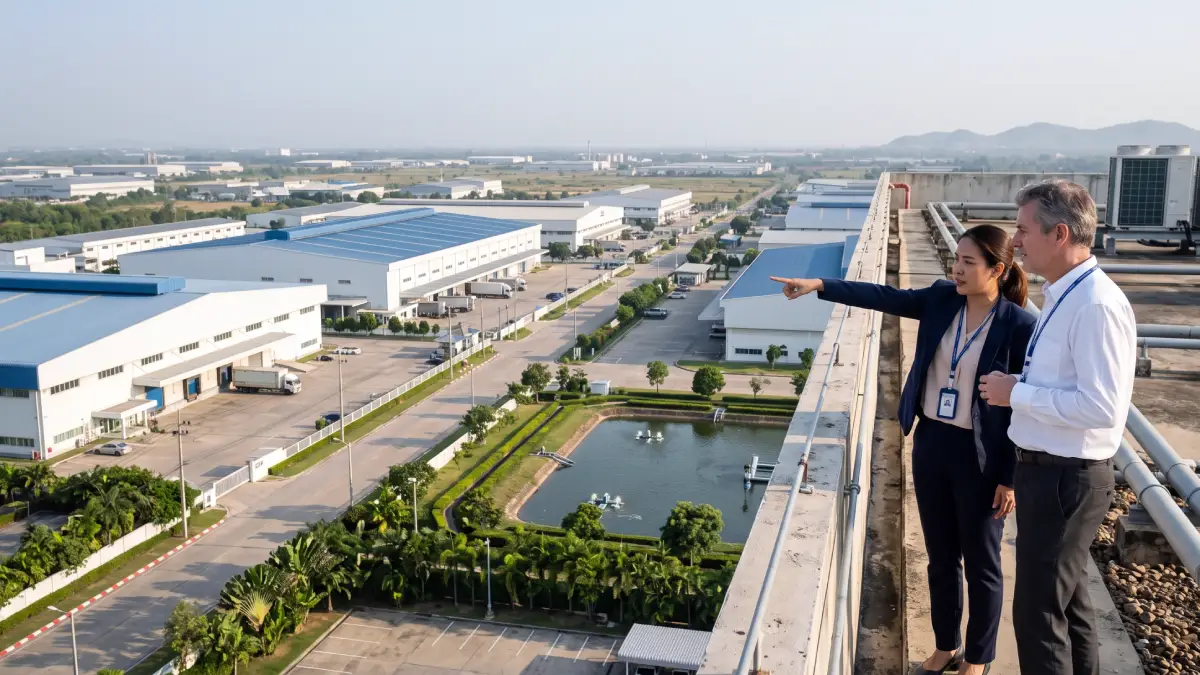
The Industrial Estate Authority of Thailand (IEAT) oversees a network of 82 industrial estates in 18 provinces. For foreign investors, they offer a rare advantage under Thai law: a foreign company can own the land of its factory outright, without a Thai partner. The right estate depends mainly on your sector, the logistics you need and the incentives you are aiming for.
Last updated: October 2026
If your project is focused on R&D or advanced technology, a science park or one of the EEC’s innovation zones may be a better fit than a conventional industrial estate. Our team helps you find the right location for your business.
What is the IEAT and why choose an industrial estate?
The IEAT is a state enterprise under the Ministry of Industry. It was set up in 1972 to develop industry outside Bangkok, and its current legal framework is the Industrial Estate Authority of Thailand Act B.E. 2522 (1979). In practice, the IEAT develops serviced land (roads, water, electricity, wastewater treatment) and gives these estates a special legal status that brings advantages not available elsewhere.
According to Krungsri Research, Thailand had 82 industrial estates in 18 provinces at the end of 2025. Only 14 are run directly by the IEAT; the other 68 are run jointly with private developers such as Amata, WHA or Pinthong. The network keeps growing, so check the current list on the IEAT website when you start your project.
The key advantage: owning your land as a foreign company
This is the main argument for setting up in an IEAT industrial estate. Under the Land Code, foreigners cannot normally own land in Thailand. Section 44 of the IEAT Act creates a specific exception: with the approval of the IEAT, an industrial operator or exporter, including a foreign company, can own land within an industrial estate for its business, in an area set by the IEAT Board.
Two points to know before you commit:
- IEAT approval comes first. The company must first obtain a permit to use the land, which can be filed through the IEAT One Stop Service, then permission to own it. The IEAT sends this permission to the Land Department, which only then registers the transfer.
- Land must be sold if the business stops. If the company stops or transfers its business, it must sell the land within three years. Otherwise, the Director-General of the Land Department disposes of it under the Land Code.
For a full comparison with land ownership under BOI promotion, see our article on BOI vs IEAT land ownership.
General Industrial Zones and Free Zones: what is the difference?
IEAT estates are divided into two main types of zone:
- General Industrial Zones: for industrial and service activities of all kinds, without a special customs regime.
- IEAT Free Zones: mainly for export-oriented activities. Machinery, raw materials and goods brought into the zone are exempt from import duties, VAT and excise tax, as long as they stay in the zone or are re-exported. Duties and taxes apply when goods leave the zone for the Thai market.
The choice depends on the share of your production that goes to export. A business mainly selling on the Thai market gains little from a Free Zone, whose rules on separating domestic and export flows add administrative work. For the details, see our article on the IEAT Free Zone.
Where are the main estates and how to choose?
The location of the estates reflects Thailand’s industrial priorities. The Eastern region alone has 54 of the 82 estates and more than three quarters of the total industrial estate area.
- Chonburi and Rayong have the largest number of estates, in the heart of the Eastern Economic Corridor (EEC), with direct access to the deep-sea port of Laem Chabang and the industrial port of Map Ta Phut. They are a natural choice for automotive, petrochemicals, electronics and export logistics.
- Chachoengsao, also part of the EEC and closer to Bangkok, is home to newer estates for manufacturing and logistics.
- Samut Prakan, close to Bangkok and Suvarnabhumi Airport, remains in demand for businesses that need to be near the capital and the airport.
- Ayutthaya and Saraburi, north of Bangkok, are long-established manufacturing locations in the central region, especially for automotive parts and electronics.
- Lamphun, in the north, is home to the Northern Region Industrial Estate, used by electronics manufacturers that rely less on direct port access.
- Songkhla, in the south, is a gateway to Malaysia and has a specialised rubber estate, Rubber City.
Land cost is therefore not the only criterion. Compare access to a port for export, the presence of suppliers and subcontractors in your sector (the cluster effect), and whether your project could benefit from the EEC’s specific incentives. Land prices in the EEC have also risen fast: according to Krungsri Research, prices in Chonburi rose by more than 40% year-on-year in the first nine months of 2025.
Combining IEAT and BOI
Setting up in an IEAT estate does not prevent you from applying for BOI promotion at the same time. The two systems are complementary: the IEAT provides the location and access to land, while the BOI provides the tax incentives (corporate income tax exemption, import duty exemption on machinery) for the promoted activity. The BOI even grants an extra year of corporate income tax exemption to some projects located in a promoted industrial estate. Most large manufacturing projects in the EEC combine both. See our complete guide to BOI promotion.
Key points
- The IEAT oversees 82 industrial estates in 18 provinces (end of 2025), most of them in the Eastern region.
- Key advantage: a foreign company can own its land in an industrial estate (Section 44 of the IEAT Act), with IEAT approval, and must sell it within three years if the business stops.
- Two types of zone: General Industrial Zones and Free Zones (export, duty and tax exemptions).
- Chonburi and Rayong have the largest number of estates, close to the ports of Laem Chabang and Map Ta Phut.
- The choice of estate depends on your sector, your port access needs and the cluster of companies in your sector.
- IEAT and BOI can be combined: location and land through the IEAT, tax incentives through the BOI.
Frequently asked questions
Can a foreign company own land in a Thai industrial estate?
Yes. Under Section 44 of the IEAT Act, a foreign company can own land within an industrial estate, with the approval of the IEAT, as long as it uses it for its business. It must sell the land within three years if it stops or transfers the business.
How many industrial estates does the IEAT oversee?
At the end of 2025, Thailand had 82 industrial estates in 18 provinces: 14 run directly by the IEAT and 68 run jointly with private developers. The number keeps growing, so check the current list on the official IEAT website.
What is the difference between a General Industrial Zone and a Free Zone?
A General Industrial Zone has no special customs regime. In an IEAT Free Zone, machinery, raw materials and goods can be brought in free of import duties, VAT and excise tax, as long as they stay in the zone or are re-exported.
Can you combine an IEAT location with BOI promotion?
Yes, the two systems are complementary. The IEAT provides the location and the land, and the BOI provides the tax incentives for the promoted activity. This combination is common for manufacturing projects in the EEC.
Which estate should you choose for an export business?
Estates in Chonburi and Rayong, in the heart of the Eastern Economic Corridor, offer the most direct access to the deep-sea port of Laem Chabang and the industrial port of Map Ta Phut. Many of them include Free Zones.
What happens if you stop your business on IEAT land you own?
The company has three years to sell the land. After that, the Director-General of the Land Department disposes of it under the Land Code.
Do you have to go through the IEAT to own industrial land in Thailand?
No. BOI promotion (Section 27 of the Investment Promotion Act) is another route to land ownership for promoted activities, outside industrial estates, but only for the land needed for the approved project. The EEC Act also allows land ownership in the EEC’s special economic promotion zones.
Conclusion
IEAT industrial estates give foreign investors rare access to full land ownership in Thailand, a major factor when choosing a production site. The right estate depends less on the advertised land price than on how well your sector, your target market (domestic or export) and the existing industrial ecosystem fit together.
Our team helps foreign investors choose and structure their industrial location in Thailand, from our offices in Chonburi and Rayong. Contact us to discuss your project.